Finding Treasures in Asian Culture & Finding Peace in a Cup of Tea
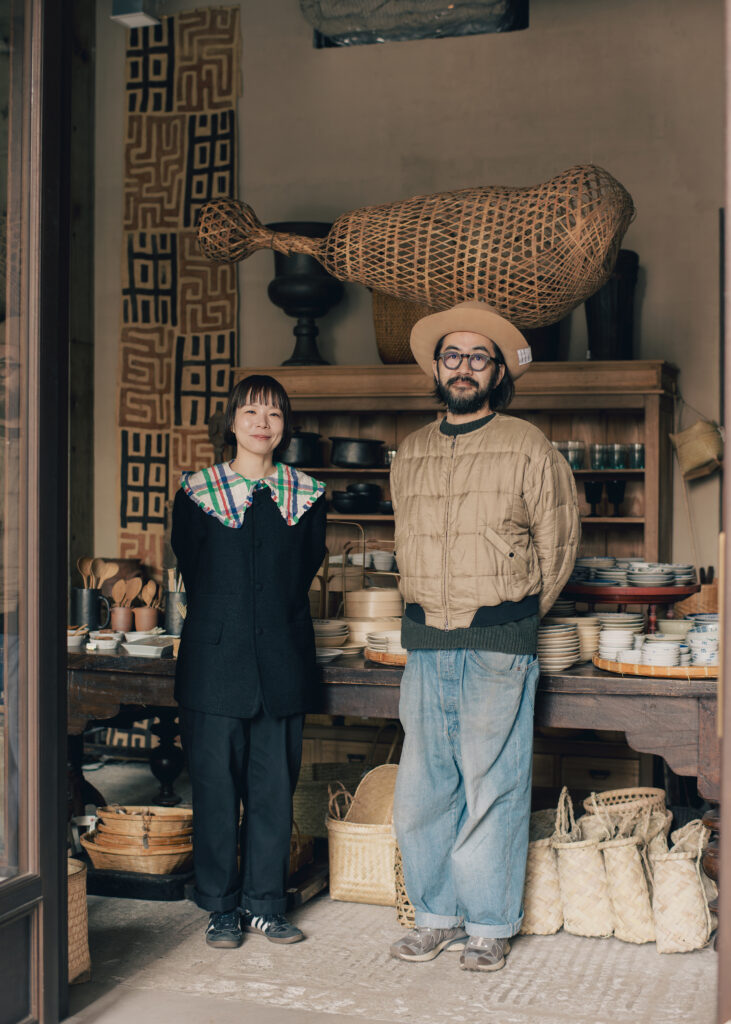
In August 2025, a new energy flowed into a corner of Kabutocho. CASICA, a brand born in Shinkiba in 2017 with the concept of "visualizing lived time and space," has established its latest base. CASICA KABUTOCHO, which houses both a shop and the restaurant CASICA Hanten, was born in this historic financial district. The space is directed by Yoshio Suzuki and Mai Hikita of the creative unit CIRCUS. We spoke with them at length about how this unique intersection of Asian sundries, antiques, cuisine, and tea came to be—from their thoughts on Kabutocho to their personal histories.
●What made you choose Kabutocho as the location for CASICA’s new space?
(Suzuki) We had received several requests from commercial facilities asking us to open a new store, but none of them really felt right. Because the Shinkiba store is quite large, I had always felt that simply creating a smaller version somewhere else would dilute the density of the shop. However, when we were approached about Kabutocho, I felt we could present something from a completely different perspective. Shinkiba has a history of being a “Timber Town,” while Kabutocho has the context of being Tokyo’s “Financial Hub.” Based on those regional backgrounds, we felt a desire to communicate with the world through the lens of Asia. We used the theme, “Tokyo within Asia,” to curate a collection of objects and food centered on the Orient, and that’s what formed CASICA KABUTOCHO.
The Asia we imagine doesn’t need to be clearly defined.
●Unlike the Shinkiba store, which has no specific genre, the Kabutocho store focuses on “Asia.” Was there a difference in your selection perspective?
(Hikita) Our core approach hasn’t changed. At CASICA, we’ve always connected disparate items, say, from Africa and Japan, through shared traits like material or texture. For this project, while the overall premise was to focus on Asian objects, the core approach remains the same. At the same time, we don’t think that just because something is from Asia, it automatically fits. We pick items from Japan and China, as well as from places like Turkey and India, searching for connections in their backgrounds and proposing new combinations. In that sense, we are re-editing Asian culture so that these objects somehow settle together as a single group.
(Suzuki) The Asia we imagine doesn’t need to be clearly defined. From the perspective of people in Europe or the United States, it might be difficult to distinguish between Japanese, Chinese, or Korean cultures. Even geographically, it’s not easy to define exactly where Asia begins and ends. History changes like a gradient, and interpretations differ by country and person. I find that kind of ambiguity interesting. That nuance is applied beyond objects to the theme of “Cross-Continental Cuisine” at our restaurant, CASICA Hanten. While “continental cuisine” usually refers to Chinese food for Japanese people, this time we provided a diverse menu that views all of Asia as one continent. We want to explore those unclear, ambiguous boundaries between countries and regions.
Personally, the enjoyment of looking comes from the joy of discovery.
●Within the limited space of the new store, were there any particular ideas behind the spatial design or the way items are displayed?
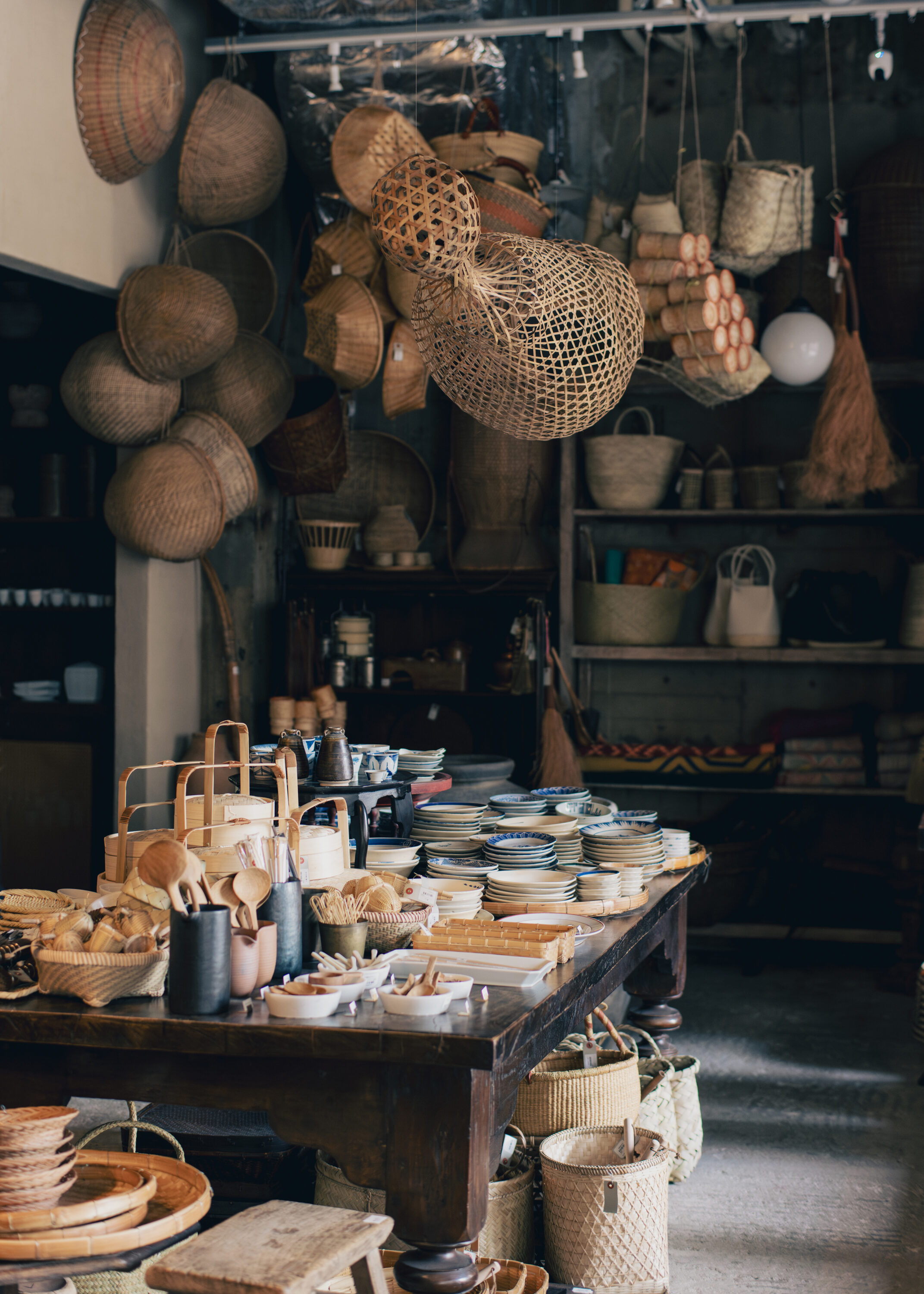
(Suzuki) Within the context of CASICA, one important idea is showing objects through volume. In the world of antiques and vintage items, the current trend may be to focus on a single piece and display it in a minimal way. But rather than a museum-style presentation that highlights one object at a time, we prefer something more like a museum of natural history, where items are shown in relation to one another as a whole. Within a large cluster of objects, the way a single piece appears can change. Even the same object can reveal a different appeal depending on how it is placed. Because we value that kind of experience, we try not to guide visitors too much or make everything overly easy to understand.
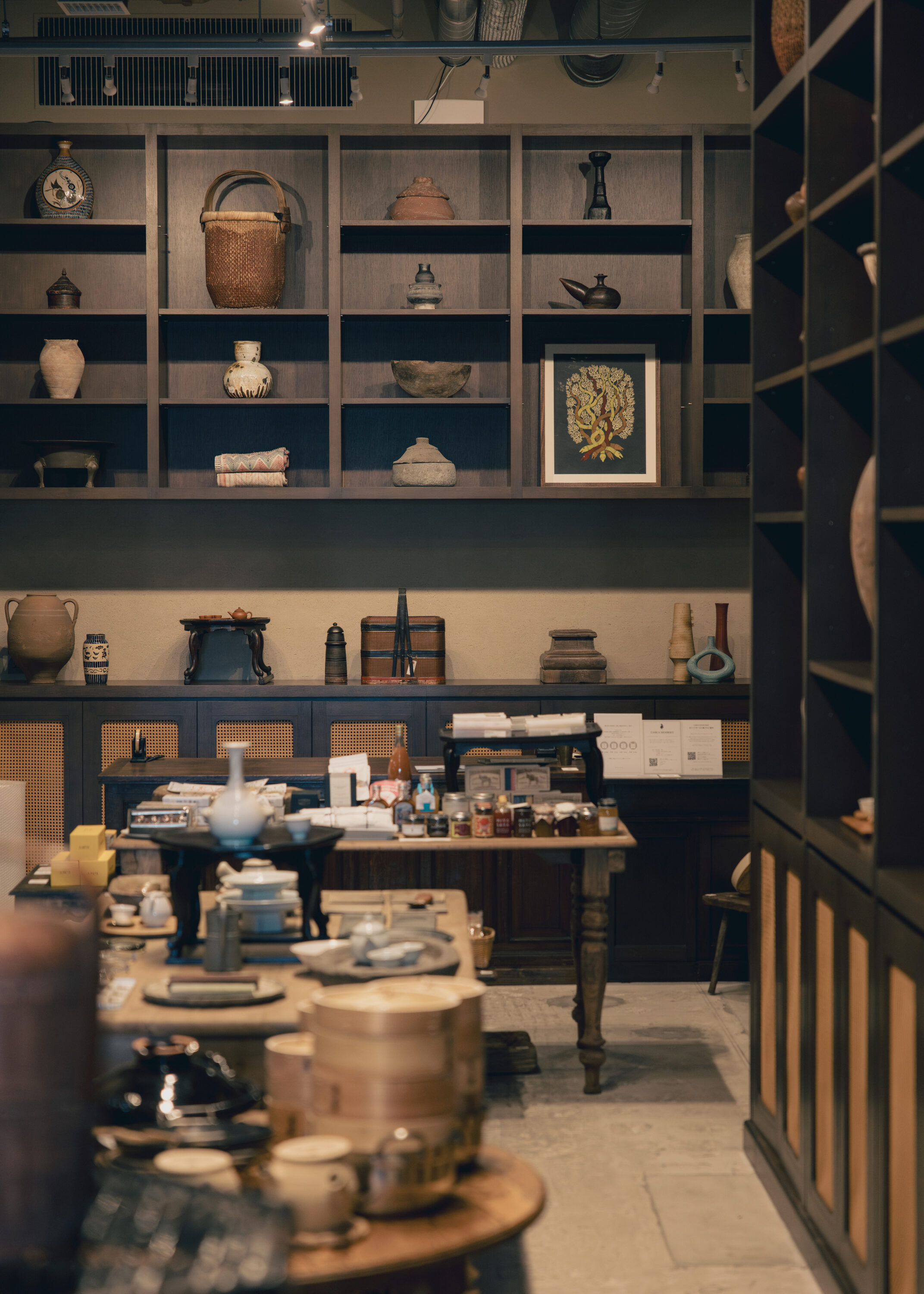
(Hikita) In addition to that approach, Kabutocho introduces something new: a contrast between the front and the back of the store. At the entrance, we created an installation-like display that expresses the lively atmosphere of an Asian market. If that kind of display continued throughout the entire shop, it might feel cluttered, so toward the back, we arranged shelves to highlight specific items more clearly.
At first glance, it might look a bit like a gallery, but it wouldn’t feel like CASICA if we simply lined up expensive items neatly one by one. Even there, we try to mix in the joy of discovery.
When we took over the space, we didn’t realize how open the ceiling actually was, so once we saw the height, we decided to create taller display fixtures.
(Suzuki) Personally, I think the fun comes from the joy of discovery. Because of that, even in the way we arrange individual items, we try to create small moments of surprise or slight discomfort. I like hiding things that visitors might only notice on their third lap around the store. We also intentionally keep some items that are difficult to sell. For example, some antique Burmese lacquerware has been here in the store for two years! But without those kinds of pieces, the character of the shop wouldn’t come through. Mixing items that sell and items that don’t is also important in establishing the identity of the store.
The "Not For Sale" items you see in some shops are always the ones that pique my interest the most!
●Are there any absolute rules for the shop?
(Hikita) Although we value ambiguity, there is one rule: everything here has a price and is for sale. The “Not For Sale” items you see in some shops are always the ones that pique my interest the most!
(Suzuki) If someone asked to buy the round tables we use in the dining space, I’d sell them!
(Hikita) Really!? Is that okay?
(Suzuki) If that happens, we’ll just go back to India and buy another one. Though I might have ask them to wait until I source it! The round table is just one example, but we are conscious of the link between food and the shop; some things used in the dining area are sold as-is. For example, the Indian Lassi cups used as chopstick holders. We also make sure the products in the back are visible from the dining area, so we hope it sparks conversations like, “What is that?” while people are eating.
Tea and artists are actually very closely connected.
●Among the items in the shop, which ones best represent CASICA KABUTOCHO?
(Hikita) The restaurant Casica Hanten is divided into three parts: lunch, dinner, and a tea-focused café. The café section was supervised by Taiwanese tea master Hsiao-Man Hsieh, so we feature many tea vessels created by artists. I think that really represents the character of this space.
(Suzuki) Tea and artists are actually very closely connected. Recently, even in Japan, more people have become interested in Chinese tea, and the number of artists creating tea utensils has been increasing. We also learned from these artists and thought that perhaps we could incorporate that culture into this space.
(Hikita) The artists themselves didn’t necessarily start making tea tools because they were asked to; rather, they began enjoying tea themselves and shaped the tools they wished existed. We reached out to artists like Daisuke Kameda, who creates beautiful white porcelain tea sets, because we felt they matched the image of this cafe. We were also inspired by the way Hsiao-man freely arranges things through “Mitate” (seeing one thing as another). When we consulted her on what tools to use for the tea service, her ideas were so free and interesting, like using a large Indian stone as a tea tray or a piece of found bamboo as a tea scoop. Encountering this new sensibility of “Mitate” culture has greatly influenced our sourcing and selection.
Kabutocho is a financial district where time tends to move quickly, so we hope people can encounter tea culture here and take a moment to slow down.
●What made you bring “Tea” into Kabutcho as a focal point?
(Suzuki) We didn’t feel the need to open a typical café here. There are already many wonderful cafés nearby. In that context, choosing tea, partly influenced by artists, felt like a natural flow. We also thought it might be interesting to introduce tea culture to Kabutocho. Generally speaking, coffee wakes you up, while tea calms you down. The way people spend time around each drink feels almost opposite.
Physically speaking, tea also takes time. Unlike coffee, it’s not something you take out and drink while walking. You enjoy it through multiple infusions. We felt that this different way of spending time might be something that this neighborhood has not had before. Kabutocho is a financial district where time tends to move quickly, so we hope people can encounter tea culture here and take a moment to slow down.
(Hikita) During the café hours at CASICA Hanten, guests can enjoy four kinds of Taiwanese tea selected by Hsiao-Man, which change with the seasons. The tea set is placed in front of the guest, and the tea is brewed together. Because the teaware is small, it’s enjoyable whether you’re alone or sharing with friends.
(Suzuki) Personally, I think antiques and tea are very similar. Both are often seen as having a “narrow entrance” or being difficult worlds to enter. By CASICA KABUTOCHO expanding into this, I hope to widen that entrance, even just a little. I’d be happy if this becomes a gateway for those who are curious but don’t quite understand it.
I’ve always felt that he sees treasures that only he can see.
●How did each of you become interested in objects and arrive at this kind of work?
(Suzuki) I’ve liked old things for as long as I can remember.About twenty years ago, the bakery where I worked part-time went out of business, and I ended up buying it on impulse. That was the beginning of everything! I started it with the simple idea that if it were my own shop, I could design it however I liked. From there, I began using reclaimed wood for interiors, commissioning old furniture, replacing doorknobs with antique ones, and even importing vintage items from overseas to sell in the shop. Those experiences eventually helped me understand everything, from restaurant flow and mechanical equipment to interiors, business numbers, and food production. I think that knowledge led naturally to my work in curation.
(Hikita) In my case, my parents running a gallery had a big influence. I grew up watching my mother invite artists and present their work, so I think my interest in objects has always been shaped by that environment. There’s also a story about Suzuki. When we had just met, we once went together to a flea market at a racetrack. It was extremely chaotic. At the time, I didn’t know much about antiques, but he said, “Among ten thousand pieces of junk, there’s one treasure,” and quietly began searching. Eventually, he came back holding a very charming Nordic-style vase and said, “It’s 500 yen.” Since then, I’ve always felt that he sees treasures that only he can see.
(Suzuki) Did I really say that?
(Hikita) You did! Curation usually separates categories: goods, interiors, and food, but he can oversee all of them and direct the entire space. I think that’s quite rare.
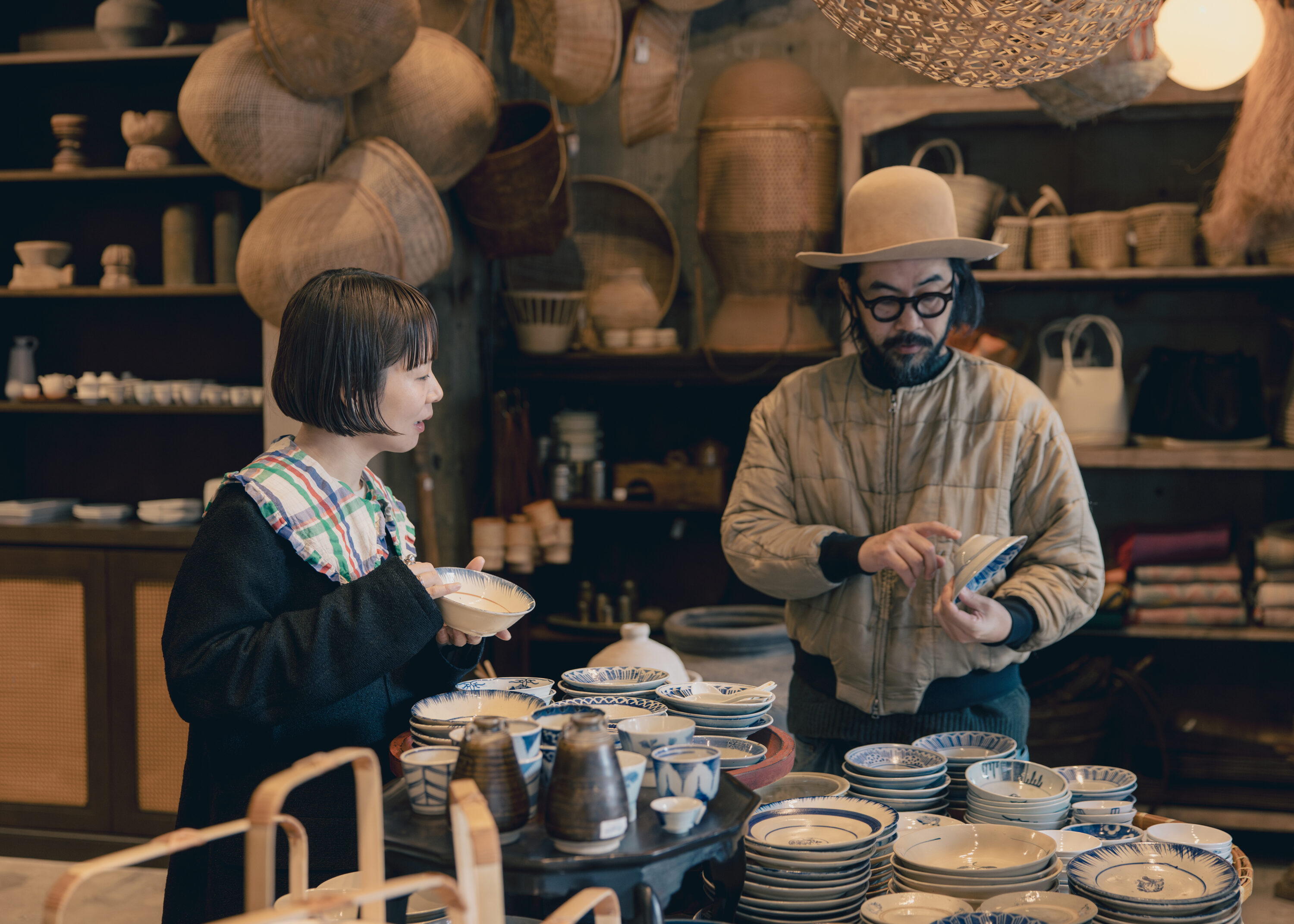
(Suzuki) Apparently, it’s useful! For me, it all started simply from liking old things, and that hasn’t really changed. I’ve always felt a little embarrassed about things that are brand-new. Even with clothes, I prefer vintage. When I bought jeans, I would rub them in the dirt or wear them until they became worn out!
●What kind of place is Kabutocho for you?
(Suzuki) It’s a neighborhood where I already had some connections through work. I helped select the minibar for K5, and I’ve known Maruyama from the izakaya restaurant, MARUYAMA, for a while. I also often visit the wine shop and bar Human Nature. In Shinkiba, we didn’t really have neighbors around us, so it’s nice to have those kinds of connections here.
(Hikita) In Shinkiba, many of the surrounding properties are large, and new shops rarely appear. Here in Kabutocho, after events, we often go out into the neighborhood at night. Though somehow we always end up at Human Nature!
At the root of everything is the desire to express the joy of shopping as fully as possible.
●How would you like to develop CASICA KABUTOCHO going forward?
(Hikita) Like the Shinkiba store, we’d like to host events here as well, perhaps pop-ups from Taiwanese apparel brands or exhibitions by Asian artists.
As for the café, what we have now is the first stage. In the next stage, we’d like to gradually introduce ways of serving tea together with food. Hsiao-Man also suggested that if there is food, we might try pairing tea with dishes, something like dim sum, where you can casually enjoy tea while eating small bites.
(Suzuki) At the root of everything is the desire to express the joy of shopping as fully as possible. When you visit markets overseas, the most exciting part is wondering what you might find. I want to continue expressing that sense of anticipation here at CASICA KABUTOCHO. In the near future, we plan to make the entrance area a bit more lively, arranging it in a way that feels like a flea market. By gradually changing things little by little, I hope we can continue sharing the fun of visiting the shop.
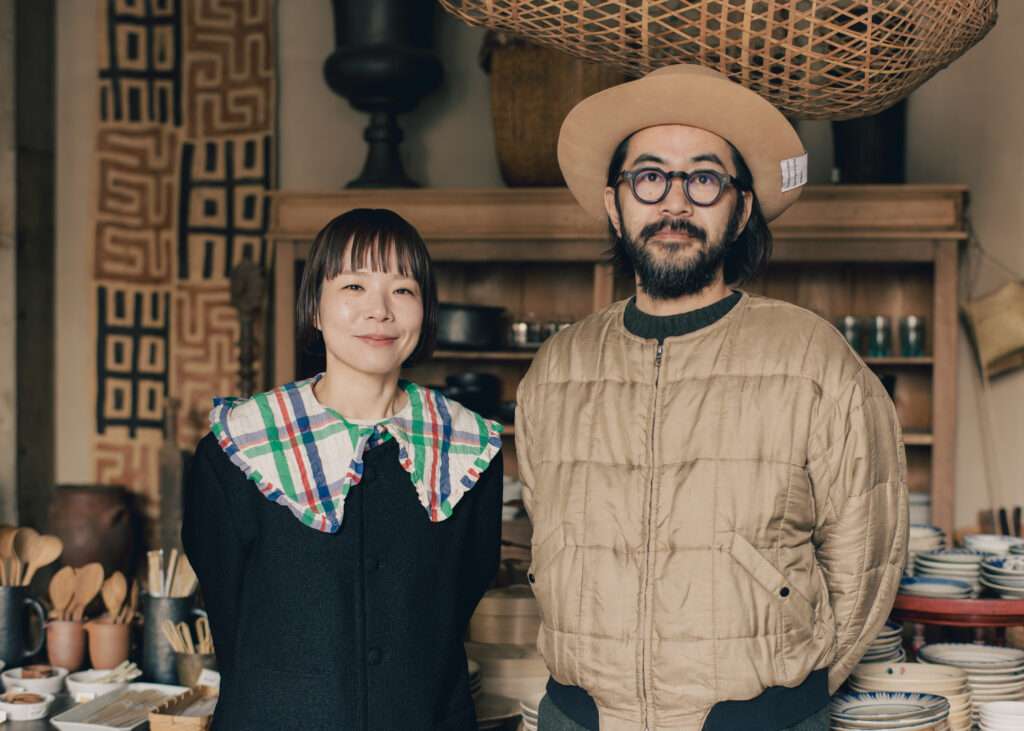
Yoshio Suzuki
Co-founder of CIRCUS. Works across food, interior design, construction, and spatial direction. Nine years ago, he founded CASICA in Shinkiba, establishing a distinctive style through the selection of antiques and vintage objects combined with immersive spatial displays. At CASICA KABUTOCHO, he is responsible for antique sourcing and overall direction.
Mai Hikita
Co-founder of CIRCUS. Responsible for artist collaborations and product selection. Raised in an environment where her parents ran a gallery, she developed a deep interest in everyday living, ceramics, and dialogue with artists. At CASICA KABUTOCHO, she works on collaborations with tea-ware artists and the design of the café space.
Interview&Text : Takuya Kurosawa
Photo : Masahiro Shimazaki
Yoshio Suzuki・Mai Hikita
CIRCUS
Eriko Numata
Food Director - Culinary Supervisor of “CAFE DANCE”
Interesting people in Kabutocho
She is a longtime friend of mine. Whenever we meet, I’m reminded of how powerful her energy is and how she is always pursuing new dreams.I find her incredibly inspiring.
The worldview she creates—shaped not only by her perspective as a chef but also by her travels around the world—always excites me.